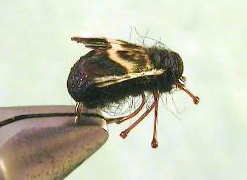
Terrestrial Beetles come in
all colors and sizes. This one
is huge. These large beetles
are fairly common in the park.
Terrestrial Insects: (Grasshoppers, Ants, Beetles, etc)
............................Fly Fishing Yellowstone National Park
Usually when you find flying
ants
on the water, you will find a
lot of them.
Terrestrial insects are insects that are born and
spend most of their life on land. They get into the
water only by accident. Windy conditions and
other natural conditions can cause these insects
to sometimes loose their caution and end up
becoming a meal for a trout.
It would be a rare occasion that trout ever
became selective on any terrestrial insect. It
would be possible during a flying ant fall, or
possibly when a large amount of ants or beetles
were washed into the water by heavy rains or
high winds. This means that most all of the time,
the trout are just looking for something to eat on
the surface of the water. They do not recognize
the various types or species of terrestrial insects
that may come floating by. The strictly feed
opportunistically on them. When there are few
insects on the water trout are likely to take every
insect that comes by.
If a large amount of any one insect became
available over a period of time, then it would be
likely that the trout would search only for that
insect or feed selectively on it. When this
happens, they begin to settle into a steady
feeding rhythm and focus on individual insects.
Facts are, it would be rare that enough terrestrial
insects fell, blew or got washed into the water to
cause selective feeding. We have never seen it
happen in the park.
Imitations of Terrestrials: (Flies)
This means that you can get by with, except for a
few rare exceptions, fishing an imitation of any
terrestrial insect you desire to imitate.  As long as
it is something of the size and shape of an
insect, the fish will see your fly as something to
eat. Their brain is not large enough for them to
be able to identify it as something they saw last
year at the particular time of the year. They they
don't need to be able to do so in order to survive.
They may eat a beetle one minute and a grass
hopper a few minutes later.
If the fly sinks, it will probably get more takes
from trout than if it floats beautifully on the
surface. Most ants, beetles and hoppers that fall
into the water slowly sink.
These are some of the more plentiful and
common terrestrial insects that get into the
freestone streams of Yellowstone National Park.
Beetles:
The most common terrestrial insect in the park is
the beetle or Coleoptera. There are both aquatic
and terrestrial forms of beetles but here we are
concerned with the terrestrial form.  Some
species of beetles can fly and these are more
likely to get into the water than the others that
cannot fly. Overhanging limbs of trees, grass and
shrubs provide the places for beetles to fall into
the water.
Ants:
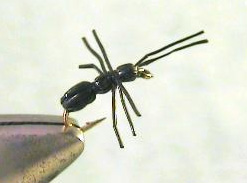
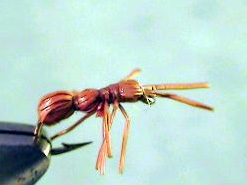
Ants, the Formicidae family of insects,  is one of  
the next most plentiful terrestrial insect found in
the park. Fast rising water caused by heavy rains
is responsible for ants and terrestrial beetles
getting into the water more than anything else.
Ants live in colonies and when they do get
washed into the water, they usually do so in large
quantities.
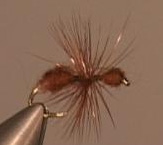
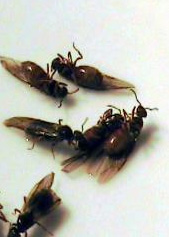
Some ants can fly and these
flying ants can
easily wind up in the water. When they do, they
are usually preyed on by trout in a feeding frenzy.
These great swarms of arts perform their nuptial
flights, the winged males or drones die shortly
after they swarm. If the flight of ants happens
over a stream they fall in the water and usually
just carpet the water. Don't stand around waiting
for this to happen, you may grow old waiting. But
if you find flying ants falling in the water, the trout
will usually go nuts. Be prepared for a flying ant
fall. They usually occur during the summer
months.  
Grasshoppers:
Grasshopper exist on every stream in the park
but they are not as plentiful in the forest as they
are in the streams that flow through meadows
and open areas where high grass exist.
Where ever you find banks with lots of grass
there most likely are lots of grasshoppers.
Grasshoppers become important starting in July
but much more so in the latter part of the
summer and early autumn. They are apt to get
into the water much more so on windy days.
Bees and Wasp:
Bees live in colonies. These colonies are usually
very large and contains thousands of insects.

Copyright 2007 James Marsh
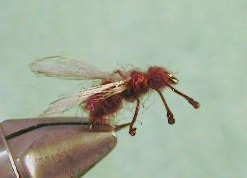
Flying Ants: This is one of
thousands that fell into the
water of the Lewis River in late
August. You should always
have a few flies ready  for them.
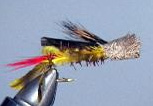
Big grasshoppers can be
found in all the meadow
streams of Yellowstone as
well as other types streams in
less quantities. .
Thumbnails: Click on
images to enlarge.