Yellowstone River - Yellowstone Lake to Yellowstone Falls:
............................Fly Fishing Yellowstone National Park
|
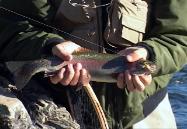
A beautiful native Yellowstone
Cutthroat Trout. Thanks to the
lake trout in Yellowstone Lake,
they are becoming less and less
of these native fish.
Fishing Bridge is closed to fishing
but a good place to observe
spawning fish.
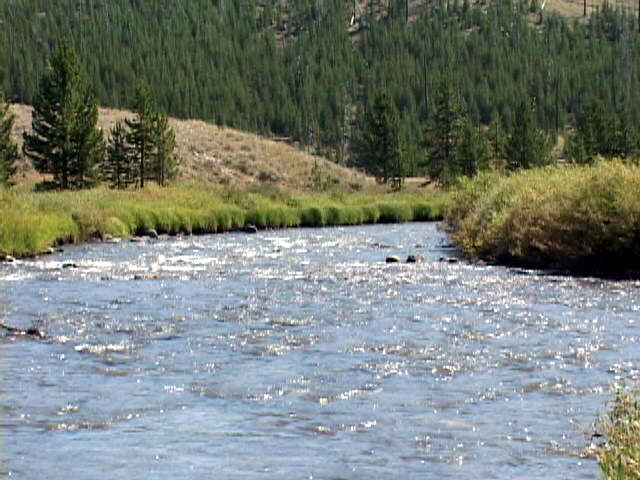
Yellowstone River near Nez Perce
Ford area looks like a huge spring
creek from a distant perspective.
An up close look proves different.
All the cutthroat trout in Yellowstone Lake are pure-strained Yellowstone Cutthroat
trout. Below Yellowstone Lake, the accessibility and popularity of the Yellowstone
River drastically changes. This portion of the river is a big and wide. It is eleven
miles from the lake to the falls. For the first few weeks, from the opening day,
currently July 15, it is unlikely you could fish anywhere above the falls to the lake
without being in sight of another angler. The fishing, in spite of this pressure, still
produces for most anglers and everyone that fishes it correctly.
The major portion of the river in this area is more like a spring creek than it is a
freestone river. Except for the Le Hardy Rapids, its flows are fairly smooth. The trout
can become a little discrete in accepting your offerings.
Lower Portion of this Section:
Much of the lower part of this portion of the Yellowstone River is closed to fishing to
protect wildlife and the fish. The area above the falls is closed to protect people from
going over the falls.
Species:
Many of the Yellowstone Lake’s cutthroat move into this part of the river to spawn.
During the months of June and July, the river is normally full of spawning cutthroat
trout. The season is not usually opened until July 15 so the first part of the spawn is
protected by the closed season. When the season first opens, fishing can be very
good if you can find a place to cast. It will be crowded. The population has declined
over the last few years but there are still a lot of fish present. By the end of August,
most of the cutthroat will move back into the Lake and leave only resident fish.
The spawning and resident cutthroats average a large size, usually 15 to 18 inches
long.
Access:
There are several pull off areas along the Grand Loop Road north of Fishing Bridge.
The road follows along the river closely.
The most popular area is Nez Perce Ford, what used to be called Buffalo Ford. It is
an area that is possible to cross earlier than any other part of the river. Because it is
shallow, it provides an excellent place for the trout to spawn. The Nez Perce Ford
area can be accessed from the Nez Perce Ford Picnic Area. The road to the picnic
area is located slightly more than 5 miles from Fishing Bridge on the Grand Loop
Road. It is just a short distance down the dirt road to the picnic area.
Another access just above the Grand Canyon is off Artist Point Road. It turns off the
Grand Loop Road about 2 and a half miles south of Canyon and crosser Chittenden
Bridge. The Howard Eaton Trail Head is located just past the bridge. You can travel
the trail in an upstream direction about a mile and then leave the trail and hike down
to the river.
Comments:
This area of the Yellowstone River has a very large and diverse population of
aquatic insects. It is very fertile water. Thank goodness the native cutthroats are not
usually highly selective, because it would not be easy to match the hatch on most
days
This area of the river is not what it was in the past. At one time, its trout was the food
supply for the local hotels. Later, it was one of the prime choice locations for fly
fishing. Now, its future is very questionable because of the lake trout in Yellowstone
Lake. They have taken a huge toll on the cutthroat population.
Is is still worth fishing? Of course. Be there on opening day and take your shot at the
fish. It is really not all that bad as far as other anglers, just a very interesting
situation. After the initial crowds, the pressure will slow down drastically. By the end
of July there will be fewer and fewer anglers but also, fewer fish. Most of them will
have moved back into the lake. This does not mean that there are no fish in the river.
There should still be some for the taking and some anglers will probally score well.
Insect hatches can concentrate the fish. So can the spinner falls and caddisfly egg
laying activity. This is the key in late July and August.
Copyright 2007 James Marsh